The US Army are responsible for producing the infamous M-1948 (M48) and M-1951 (M51) fishtail parka’s. The no expense spared parkas were made using the finest materials in order to combat the severe Korean winters. It is no wonder that the British Mod movement adopted these war coats to protect their clothing when riding out.
Tweet
Parkas were the most appropriate combat clothing in Korea’s frigid winters. Soldiers wore parkas as windproof outer shells when cold weather became too severe for field jacket and liner combinations. Several World War II era parka models were used, but their closed-front designs restricted wear and convenience. The Parka, Field, Cotton, Olive Drab, was long skirted and had a large front pouch pocket with two side openings. This cotton field parka was worn over the Parka, Field, Pile. The pile field parka was a bulky, hair-lined garment that was not windproof and rarely worn by itself as an outer coat. The Parka, Ski, Reversible, Fur Trimmed, was an olive drab outer shell with an inner layer of white for snow camouflage.
After World War II, the Army developed a combat ensemble that provided the flexibility of a coat and better layering under extremely cold conditions. The Parka-Shell, Cotton, Olive Drab, M1948, and Parka-Liner, Pile, M1948, were adopted in 1949 and produced under specification that was approved on 25 July 1950. The parka-shell was made of wind-resistant cotton sateen in Olive Drab shade 7 and featured a snap-and-slide fastener closure, slit front pockets, and a patch pocket on the upper left sleeve for pencils and cigarettes. The hooded parka liner was composed of wool-pile cloth in Olive Drab shade 30A.
The Parka-Shell, M1951 and its companion Parka-Liner, M1951 were adopted 27 June 1951. The parka-shell’s integral cloth hood could attach over the separate fur-trimmed M1951 parka hood or under the helmet. The parka-shell was made of a water-repellent cotton-nylon blend in Olive Green shade 107. The slide-fastening opening, pocket arrangements, and draw-cord design incorporated improved features. The parka-liner, made of 16-ounce mohair frieze, had no hood. The combination was scheduled for every soldier in Troop Categories A, B and C during six months of annual utilization in Korea, but its sporadic appearance very late in the war prevented this.
The M1948 and M1951 parka-shells and parka-liners were not normally interchangeable. There was some latitude, however, because the next larger or the next smaller liner could be fitted with other parka-shell models. Many parka combinations were used, as demonstrated by the fact that the Eighth Army distributed more than 331,000 for its final 1952-53 winter campaign. As of July 1953, available Eighth Army inventory still totalled less than a quarter of the 367,401 M1951 parka-shells and 360,912 M1951 parka-liners required for complete winter distribution.
Fishtail Parka - Clothing Requirements and Supply
U.S. Army clothing and individual military equipment were used to protect and sustain soldiers in the performance of their military duties. This task was complicated by the wide range of climatic, combat, and geographic extremes encountered in Korea. Clothing difficulties were further magnified by battlefield fluctuations and inadequate supply stocks, especially in the first 12 months of the conflict.
Korea is rugged and mountainous, and movement across its ranges and narrow river valleys caused hard wear on clothing and load-bearing equipment. The peninsula’s oceanic extension from 34 to 43 degrees north latitude places it within the cold-wet clothing environment. Drastic temperature changes are caused by seasonal reversals in prevailing winds, and the climate is dominated by frigid but relatively dry winters and hot, moist summers.
The northern Asian-continental winter climate of Korea is intensified by arctic winds driven across Siberia. These winds could strip heat from the body despite multiple layers of cold-climate clothing. Battle situations often forced troops to move or remain stationary (sometimes even pinned down) while fully exposed to subzero weather, causing much frostbite and many other cold-related injuries.
Army clothing also had to meet the demands of the hot summers. At this time, there is either heavy rainfall or oppressive heat accompanied by high humidity. The monsoon spring and autumn transitional periods are marked by highly variable winds and storms. During the spring, dust tempests arrive from the desserts of Mongolia and northern China. From summer through early autumn, an average of five typhoons lash the peninsula with torrential rains.
The sudden communist invasion and the later Chinese intervention caught the United States off guard militarily. The closest depots to Korea were in Japan, but material levels were very limited and winter field garments were scarce worldwide. The Army did not stock sizable amounts of special clothing for extreme cold because military preparations and procurement planning were based primarily on temperate zone operations. The Korean crisis created severe difficulties in textile acquisition and production, resulting in higher costs and delayed deliveries.
Wool shortages quickly developed, and 18 ounce serge jumped from a low of $3.74 a yard in May 1950 to a high of $8.67 by February 1951. Cotton supply problems were partially alleviated by authorizing variations in weave or finish, and by substituting other fabrics for uniform twill, oxford, and sateen. Newer synthetic fibres, such as lightweight rayon twill used in lining caps, coats, and jackets, were also scarce. The lack of rayon acetate delayed contracts for parkas and newer field jackets, while nylon shortages curtailed production of raincoats, ponchos, and parkas.
Header

Showing posts with label fashion. Show all posts
Showing posts with label fashion. Show all posts
Wednesday, November 14, 2012

Friday, July 10, 2009
Liam Gallagher Sports An M-65 Fishtail Parka At Wembley Stadium

Thursday, 09/07/09 was a long damn day……
The BBC picked me up at 10am to take me down to Hendon for filming for Car Booty…..!!….Yes, someone found a parka in their attic and they wanted me to value it etc…..comical !!
Then they dropped me off in Wembley. Where I waiting around for my bro to finally get down there too as we were off to Oasis. Having taken a complete M-51 with me for the filming I was left wondering around with it…..and in the end decided to keep it on for the concert as it was sure to get cooler…
I soon realised I was the only person out of the 60,000 packed into Wembley wearing a genuine or indeed any kind of Fishtail Parka….
Then, after The Enemy and Kasabian the big moment came….
Oasis are now on stage…….and I was now the second person in Wembley wearing a genuine Fishtail Parka…..
The fact that it was indeed the same parka he bought from us, just kinda made it all even better !! :)….
After a long day, the very toughest months of my life…..it all seems worth it again. Thanks Liam :)
More pics and video to come.
Copyright FishtailParkas.com 2009: No part of this article may be copied, transmitted, stored or used in anyway without the express permission of fishtailparkas.com
Wednesday, October 11, 2006
Oasis's Liam Gallagher Get Into An M-1951

Oasis's Liam Gallagher Get Into An M-1951
Copyright fishtailparkas.com
When Liam was looking for the right parka to wear for their new video, guess who he came to.
Yep, you guessed it...:)....fishtailparkas.com
Liam is wearing a genuine and complete m-1951 in their lastest promo video for their up and coming album "stop the clocks".
Ahead of the release of Oasis’ first ever Best Of album ‘Stop The Clocks’ (out on November 20th) and the release of the previously announced ‘collectors’ EP of the same name on NOVEMBER 13th. Oasis have made a brand new promo video to accompany ACQUIESCE, which features on the EP the video has it first has its world wide online premiere on Yahoo Thursday 5th October.
The video was shot on location in London and Japan and features a range of Oasis look-a-likes - its a video not to be missed!!! The video also gets its first UK TV showing today at 11pm on ITV2.
You can see the Acquiesce video here http://www.youtube.com/watch?v=M6KPRZ8FdQs
Look out for my parka...:)....and more pics and video when I get it....:)...
Fishtailparkas.com
Friday, February 17, 2006
The Fishtail Parka, from war coat to fashion icon...
Copyright 2006 fishtailparkas.com
The fishtail parka started life in service to the US army in 1951 to help the American soldiers cope with the freezing conditions in the Korean War.
It was known as the M1951 parka and those wanting the full history on this please see Article©: M1951 Fishtail Parka, history of the vintage M51 parka.
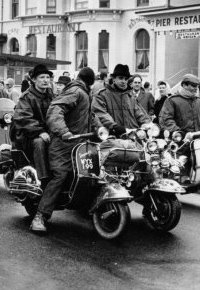
However, in 1960’s Britain the Fishtail Parka took on a whole new life and came to represent an entire era, a lifestyle and a statement of intent.
You were a Mod.
By 1963 the mods were here, they had their own style, their own dress codes, their own transport and indeed their own language. In a fashion culture that changed on a weekly basis forcing mods to work overtime to keep up with the changes, everything from colour to length of jacket side vents, to width of trouser bottoms and style of shoes only one item of clothing managed to stay a constant throughout the life of Mod.
This was the Fishtail Parka (US Army only).
The truth is that exactly how this came about no one really knows, it’s as much a mystery and it is a phenomena. The influencing factors can readily be drawn, fishtail parkas were cheap, warm, relatively water proof and great for riding scooters in a pre-helmet era as one could tie the fur hood right up around your face. Plus, no one else was wearing them on the street and that was important to the mods.
However, no one really knows who started it and how it caught on so quickly. It’s not like anyone can say oh that was Dave, he got one in Whitechapel for a bob and we all thought; “fuck it!…. let’s all get one”.
Therefore, one is left thinking, why not any other warm coat of that time…why that parka and why ONLY that particular parka ??
Yes we all know mods wore other jackets and coats but only one coat kept its place as the first choice for scooter riding and only one coat became the most prolific symbol of Mod and that was the Fishtail Parka.
For me, it is not hard to imagine the early 60’s and a small group of early mods, or maybe even “Coffee Bar Cats” seeking out a warm coat and stumbling across a US Army M1951 Fishtail Parka in the local Army Stores. And seeing the price, seeing the quality, seeing the benefits of warmth, head protection and durability, and the fact that no one was wearing them, made the choice that this was the coat to wear.
They rode back into town adorned in their new gear, espousing the benefits of being warm and dry, the next day 4 more mods went back to that same army store and got themselves kitted out. Within a week, you a one gang of 12 mods all riding around wearing the same Fishtail Parkas.
The same processes took place as they chatted with the mod gang in the next block, and Mr Army Stores was having a good month with lots of new visitors. These early mods, being the trendsetters and likely to be looked up to by new and aspiring mods, were soon copied.
By 1964 Mod was in full swing and thousands of mods were now springing up all over London and all needed to complete their uniform.
And by 1965, Mr Army Stores had retired to a small condo in St Moritz and every mod in London had a M1951 Fishtail Parka…
No part of this article may be copied, transmitted, stored or used in anyway without the express permission of fishtailparkas.com . If you wish to use this article simply contact me.
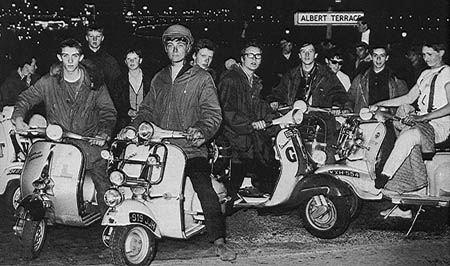
The Mods: where did they come from ?
Copyright 2006 fishtailparkas.com
Far apart from the golden age of 1950's America, 1950's Britain was still on rations, and struggling to get over the devastation suffered in World War II.
However, for the British youth a new dawn was rising. Thanks to full employment and hire purchase and a new found freedom from National Service, the British youth was on their own two feet with money in their pocket and they wanted everybody to know about. A new movement known as the "teddy boys" was emerging across the UK influenced by American Rock ‘n’ Roll. As Bill Haley's cult movie "Rock Around The Clock" premiered in the Trocadero in London's Elephant and Castle, followed by outrage from the British establishment and joyous riots from the youths, the Ted movement was now alive and kicking.
Ever eager for a scoop, the press did not fail to capitalise on this new front page fodder. Soon the violence, and imminent danger that the Teddy Boys posed to British society was all over the front pages. From the prime minister to the archbishop, the British establishment was in turmoil as they watched their once dutiful youths turn into unruly wild cats. Whether much of this was by natural progression or greatly fuelled by the press, the outcome was a rough, dangerous youth movement that was loving every minute in the limelight and indeed acting up to it.
The teddy boys were here and soon the music makers and fashion retailers caught on to a new and untapped market. Very soon, commercial Rock’n’Roll was being slopped out and Teddy Boy fashions were on the high street and every kid wanted a quiff and a flick-knife. Thus, almost as quick as they had come, they were burnt out by their own famed notoriety and at now at odds with themselves for becoming everything they despised, just another high street fad, the Teds were gone.
By late 1950’s the original teddy boys were no more, broken up into various sub cultures, most fell by the wayside but two major groups remained and grew from the ruins of what was once the Teddy Boys to become the “Ton Up Boys” and the “Coffee Bar Cats”…
The “Ton Up Boys”, were those teddies that had held the motorcycle and American Rock’n’Roll as their foundations and now wore leather, big boots and rode British machines to and from various road side cafés.
The “Coffee Bar Cats” aspired to a more Latin look, and their neo Italian style appreciated modern jazz, ventless thin lapelled box suit jackets and they chose Italian scooters as the superior mode of transport for such well dressed Cats…It’s not hard to figure how these late 50’s early 60’s sub culture’s and indeed underground fashions grew into the Mods and Rockers of the mid 60’s.
The Coffee Bar Cats felt they were the modern movement and the Ton Up Boys represented all that was gone and should remain buried in a pile of dirty bikes and dirty leathers. Hence as they grew and needed to encompass all their new members, they eventually termed themselves the Modernists and the Mods were born.
The “Ton Up Boys”, enjoying the same growth in numbers and being known for their love of Rock ‘n Roll found themselves becoming the Rockers. Unsurprisingly the Rockers did not agree with the Modernist view of themselves as outdated and somehow lower class. They saw the Mods with their dandy dress, penchant for wearing eyeliner and popping pills at every opportunity as an insult to all that is British and macho.
The Rockers did not like the Mods and the Mods did not like the Rockers.
The lines were drawn…..
No part of this article may be copied, transmitted, stored or used in anyway without the express permission of fishtailparkas.com . If you wish to use this article simply contact me.
Subscribe to:
Posts (Atom)